
What Is Net Metering? Net Metering vs Net Billing, Explained With Real Numbers
What is net metering? Learn how utilities credit the solar power you export, how net billing differs, and how much each rule is worth on a typical home.
California NEM 3.0 pays a few cents for exported solar. See how net billing, the 9-year lock-in and the new fixed charge shape savings in 2026.
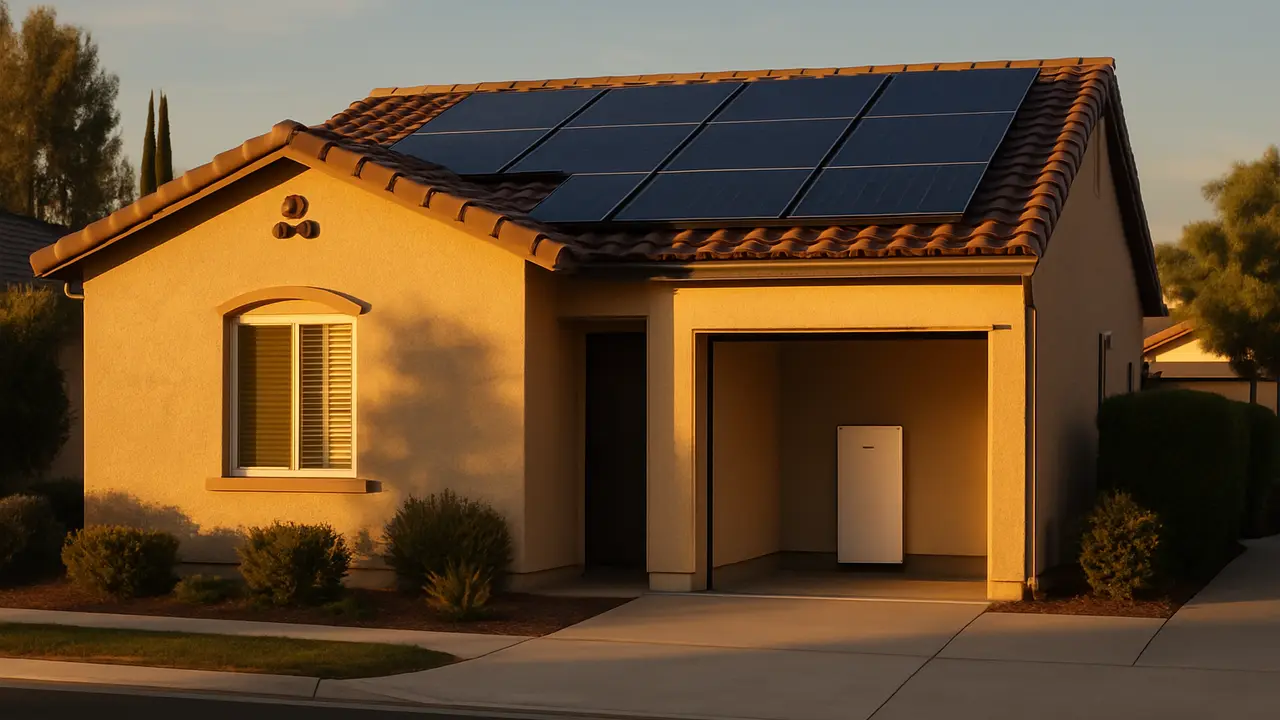
California NEM 3.0 is the state's Net Billing Tariff, and it changed rooftop solar from a "spin the meter backward" deal into a "use your own power" deal. Since April 15, 2023, new PG&E, SCE and SDG&E solar customers get hourly export credits worth a few cents per kWh, while still paying full retail rates for power they buy.
That does not make solar a bad buy in California. Retail prices here are among the highest in the country: the average California home paid 33.25¢ per kWh in January through July 2026, against a U.S. average of 18.19¢, according to the EIA's Electric Power Monthly (opens in a new tab). Every solar kWh you use yourself avoids that price. The trick under NEM 3.0 is designing the system so you use more of it.
NEM 3.0 is the nickname for the Net Billing Tariff the California Public Utilities Commission adopted in Decision D.22-12-056 (opens in a new tab) on December 15, 2022. It applies to customers of PG&E, SCE and SDG&E who submitted an interconnection application on or after April 15, 2023. PG&E and SCE label it the "Solar Billing Plan."
The CPUC's net billing tariff page (opens in a new tab) confirms the April 15, 2023 start and notes that Resolution E-5301 (November 30, 2023) finalized the tariff details. The decision's stated goal was to cut the cost shift to non-solar customers and push new systems toward solar paired with storage, because California's grid has plenty of midday solar and needs help in the evening.
Who is not covered: customers of municipal utilities such as LADWP and SMUD, which set their own rules. If you buy power from a community choice aggregator inside PG&E, SCE or SDG&E territory, your delivery side follows the net billing tariff, and your CCA decides how it values generation.
Under NEM 2.0, each exported kWh earned a credit close to the retail rate, so the grid worked like a free battery. Under NEM 3.0, exports earn avoided-cost values that are usually a fraction of retail. Imports still cost full price. The result is that self-consumption, not exporting, drives savings.
| Feature | NEM 2.0 (applied by April 14, 2023) | NEM 3.0 / Net Billing Tariff |
|---|---|---|
| Export credit | Near the retail rate, minus small non-bypassable charges | Hourly Avoided Cost Calculator value, often a few cents |
| Rate plan | Time-of-use | High-differential electrification rates (PG&E E-ELEC, SCE TOU-D-PRIME, SDG&E EV-TOU-5 at launch) |
| How long terms last | 20 years from interconnection | Nine-year legacy period, tied to the customer who installed |
| Billing | Monthly statements, annual true-up | Monthly statements, annual true-up |
| Bonus credit | None | ACC Plus "Energy Export Bonus" for early residential adopters, stepping down to zero |
| Best design | Size to cover 100% of yearly use | Size for self-use; add storage for evening use |
The decision kept the annual true-up. You still get monthly statements, and credits roll forward until a 12-month true-up statement settles the balance. PG&E's Solar Billing Plan page (opens in a new tab) describes the same monthly-plus-true-up cycle.
Export credits come from the CPUC's Avoided Cost Calculator, which estimates what the utility saves when your power replaces other supply. Values change by month, hour and weekday or weekend. PG&E says they range from roughly two cents to more than two dollars per kWh, with the highest values on a handful of late-summer evenings.
Most rooftop exports happen around noon in spring and summer, when values sit at the low end. That is why the site's NEM 3.0 calculator uses an average export credit of about 8¢ as a starting point and lets you change it. You can see your own hourly credits in your utility online account once your system is running.
Customers who enroll during the first five years of the tariff get a "lock-in": a fixed nine-year schedule of hourly export values, taken from the calculator version adopted on January 1 of their interconnection year. PG&E describes the window as customers who start on the Solar Billing Plan before 2028. After nine years, exports are valued at the most recent calculator. People who enroll after the transition get no lock-in.
To keep payback near nine years during the transition, the decision added a per-kWh export adder for residential customers. The initial values were $0.022 per kWh for PG&E and $0.040 for SCE non-CARE customers, and zero for SDG&E, whose high rates already met the target. The adder drops 20% of its first-year amount each calendar year and reaches zero after year five. PG&E lists its 2026 residential value at about $0.009 per kWh, locked for nine years at permission to operate.
The biggest bill change since NEM 3.0 is the income-graduated fixed charge the CPUC adopted in Decision D.24-05-028, now called the Base Services Charge. It is $24.15 a month for most households, $12.08 for FERA and qualifying affordable housing, and $6 for CARE, according to the CPUC Energy Division's implementation update (opens in a new tab).
SCE and SDG&E began billing it in the fourth quarter of 2025, and PG&E started in March 2026. In exchange, per-kWh prices dropped. The CPUC estimated summer peak reductions of about 4.6 to 6.8 cents per kWh, based on 2023 revenue requirements.
For solar owners, two details matter:
Numbers make the NEM 3.0 trade-offs concrete. This example uses the same formulas as our calculator and plausible 2026 PG&E inputs. It is an illustration, not a quote; your usage pattern and the hourly export values on your account will move the result.
Assumptions: the household uses 9,000 kWh a year. A 6 kW system produces about 9,300 kWh (roughly 1,550 kWh per kW, typical for inland California). Without a battery, 35% of production is used as it is made. Average import price is 40¢ per kWh, which sits between PG&E's E-ELEC summer off-peak (33.4¢) and peak (55.2¢) on the current tariff sheet (opens in a new tab). Average export credit is 7¢.
If the solar system costs $18,000 ($3.00 per watt), simple payback is about 10.4 years on $1,725 of savings, before rate increases. If the battery adds about $15,000, its own payback is about 14 years on $1,057 a year. Berkeley Lab found that paired solar-plus-storage systems cost a median $2.10 per watt more than solar alone among cash-purchase residential systems installed in 2025, in its 2026 data update (opens in a new tab). Try your own inputs below.
Size for self-use, not for the yearly total. Under net billing, the last few panels on an oversized system mostly export at low midday values, so they pay back slowly. A smaller array that covers daytime use, plus load shifting or a battery for evenings, usually earns more per dollar spent.
Practical moves that help under net billing:
To size backup storage for outages separately from bill savings, use the solar battery size calculator.
Often, yes, in California more than anywhere else. A battery turns low-value midday exports into avoided peak purchases worth 30 to 55 cents. That spread is why Berkeley Lab found California's residential storage attachment rate jumped from 14% in 2023 to 57% in 2024 after the tariff changed.
Still, the battery has to pay for itself on its own merits. Run the price spread through the time-of-use battery calculator and compare the payback with the warranty term. For a full look at costs, outages and alternatives, read our guide on whether solar batteries are worth it.
As of October 2026, there is no federal income tax credit for California homeowners who buy solar or batteries completed in 2026. The IRS confirms the 25D credit is not available when installation is completed after December 31, 2025, even if you paid in 2025 (IRS FAQ (opens in a new tab)).
Leases and PPAs are different. The company that owns the system may still claim a business credit under section 48E if it meets construction deadlines and sourcing rules, and some of that value can show up in a lower monthly price. Our federal solar tax credit guide explains the timing rules. For property tax treatment and local programs, see solar incentives by state.
Check that the quote models net billing honestly. Many disappointed NEM 3.0 customers were shown savings based on retail-rate credits that no longer apply. Ask for the numbers behind the estimate and compare them with your own bills.
If you want to see how net billing compares with the classic one-for-one model used in many other states, read net metering explained, then run your own California numbers through the NEM 3.0 calculator.
No. The official name is the Net Billing Tariff, adopted by the CPUC in Decision D.22-12-056 on December 15, 2022. PG&E and SCE call it the Solar Billing Plan on bills and websites. Installers and homeowners use NEM 3.0 as shorthand because it replaced NEM 2.0.
Usually not. If your complete interconnection application was submitted by April 14, 2023, you stay on NEM 1.0 or NEM 2.0 for 20 years from your interconnection date, according to the CPUC. Adding panels can change your status, so ask your utility before you expand an older system.
It depends on the hour, day type and month. Credits come from the CPUC's Avoided Cost Calculator, which PG&E says can range from about two cents to more than two dollars per kWh. Most exports happen at midday in spring and summer, when values are low, so the average credit is usually a small fraction of the retail rate.
Customers who enroll during the tariff's first five years get a fixed nine-year schedule of hourly export values from the Avoided Cost Calculator in effect for their interconnection year. After nine years, exports are valued at the latest calculator values. Customers who enroll after the five-year transition get no lock-in.
No. PG&E and SCE both state that solar generation credits cannot offset the Base Services Charge, which is about $24.15 a month for most customers. SCE notes one exception: leftover Net Surplus Compensation or Energy Export Bonus credits can be applied to it. CARE and FERA households pay a lower amount.
No, but it often improves the numbers. A battery stores midday solar that would earn a few cents as an export and uses it in the 4 to 9 p.m. peak, when you would otherwise pay 30 to 55 cents. Whether that pays back depends on the battery price and how much you use in the evening.
Under D.22-12-056, the nine-year net billing legacy period is tied to the customer who installed the system, not to the system. A later owner does not get the legacy period, except a spouse or domestic partner. Ask your utility how this applies before you list or buy a home with solar.
Not for homeowners who buy. As of October 2026, the 30% Residential Clean Energy Credit (25D) ended for systems whose installation was completed after December 31, 2025, under Public Law 119-21. A leasing company or PPA provider may still claim a business credit on systems it owns.
No. The CPUC's net billing tariff covers the three big investor-owned utilities: PG&E, SCE and SDG&E, including customers who buy power from a community choice aggregator in those areas. Municipal utilities such as LADWP and SMUD set their own solar rules, so check with them directly.
What is net metering? Learn how utilities credit the solar power you export, how net billing differs, and how much each rule is worth on a typical home.

Are solar batteries worth it? See 2026 battery costs, when time-of-use savings and backup pay off, and why the answer differs in CA, AZ and TX.

Solar incentives by state for 2026: state tax credits, property tax exemptions, rebates, SRECs and the export rules that matter most now that 25D is gone.

Federal solar tax credit 2026: 25D ended for systems finished after 2025. See who can still claim, carryforwards, leases, PPAs and state credits.