
California NEM 3.0 in 2026: How Net Billing Changes Solar Savings
California NEM 3.0 pays a few cents for exported solar. See how net billing, the 9-year lock-in and the new fixed charge shape savings in 2026.
Are solar batteries worth it? See 2026 battery costs, when time-of-use savings and backup pay off, and why the answer differs in CA, AZ and TX.
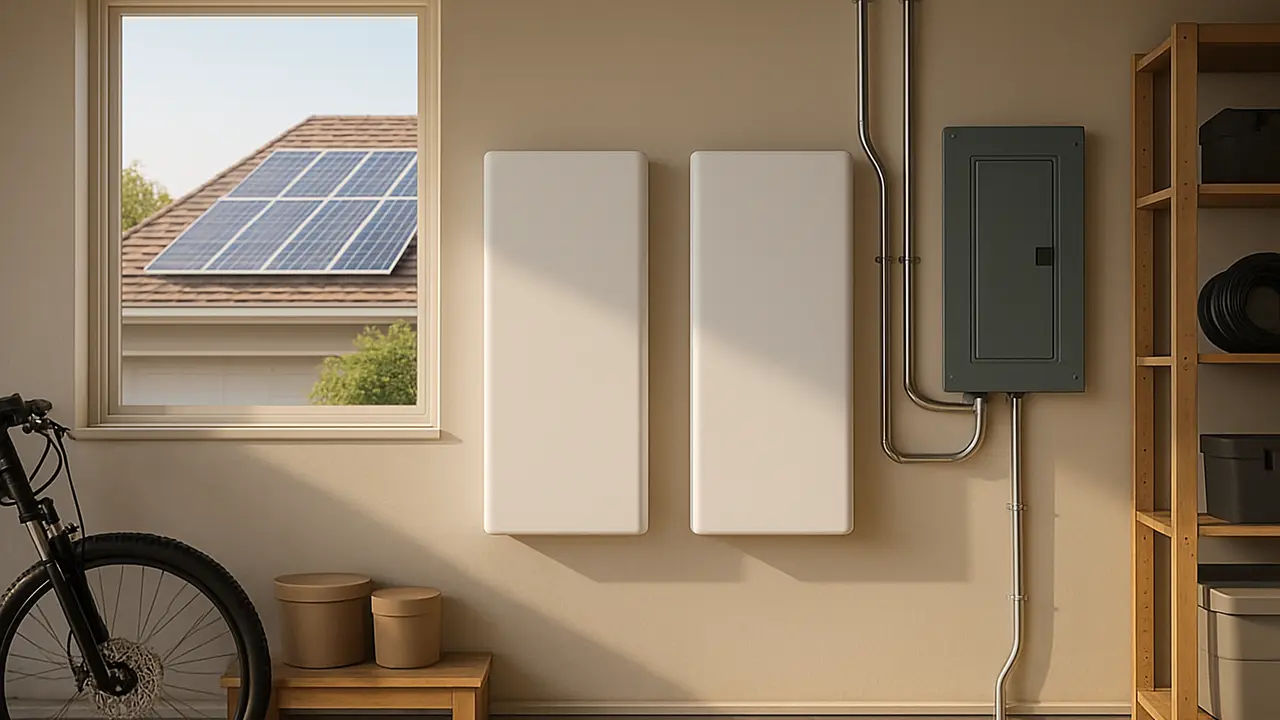
Are solar batteries worth it? In 2026 the honest answer is "sometimes, and it depends mostly on your utility." A battery pays off when exported solar earns little and evening power costs a lot, as in California, or when outages are frequent and costly for you. Under full one-for-one net metering, a battery rarely saves enough to justify its price.
This guide walks through what batteries cost now that the federal credit has ended for owners, the three ways a battery creates value, and worked numbers for California, Arizona, Texas and a full net metering state.
A single home battery adds thousands of dollars to a solar project, and more if your electrical panel needs work. Berkeley Lab's data shows paired solar-plus-storage systems cost a median $2.10 per watt more than solar alone among cash purchases installed in 2025.
That figure comes from Berkeley Lab's U.S. Distributed Solar and Storage 2026 Data Update (opens in a new tab) (August 2026). On the median 2025 residential system of 7.7 kW, $2.10 per watt works out to about $16,170 of extra cost. The same report put the median paired battery at 13.5 kWh. About 80% of the paired pricing data came from California, so treat it as a guide, not a quote.
The big 2026 change is the tax credit. The IRS confirms (opens in a new tab) that the 30% Residential Clean Energy Credit does not apply when installation is completed after December 31, 2025, even if you paid in 2025. As of October 2026, a homeowner who buys a battery pays the full price unless a state or utility program helps. A battery owned by a leasing company may still earn that company a business credit under section 48E, which can show up as a lower monthly payment.
A battery earns its keep in three ways: shifting solar from low-value hours to high-price hours, keeping essential circuits running during outages, and earning payments from utility programs that borrow its stored energy. Most homes that come out ahead stack at least two of the three.
A battery saves real money when the gap between your peak price and your export credit is wide, and almost nothing when the gap is narrow. That is why the same battery can pay back in about a decade in California and never pay back in a state with full retail net metering.
California is the clearest case. Under the Net Billing Tariff (opens in a new tab), most solar exports earn a few cents per kWh, while PG&E's E-ELEC rate charges about 55.2¢ per kWh from 4 to 9 p.m. in summer and 33.4¢ off-peak, according to its current tariff sheet (opens in a new tab). Berkeley Lab's 2025 data update (opens in a new tab) found California's residential storage attachment rate jumped from 14% in 2023 to 57% in 2024 after the rule change.
Here is how the same 13.5 kWh battery, priced at $15,000, performs under different rules. Each row uses our time-of-use battery formula with 90% round-trip efficiency.
| Situation | Peak price avoided | Value of the stored kWh | Cycles a year | Yearly savings | Simple payback |
|---|---|---|---|---|---|
| California net billing (blended peak) | 45¢ | 7¢ export credit | 300 | $1,357 | 11.1 years |
| California, summer-peak only (illustrative) | 55¢ | 7¢ | 300 | $1,721 | 8.7 years |
| Arizona RCP export, hypothetical 25¢ peak | 25¢ | 5.554¢ (APS 2026 RCP) | 250 | $572 | 26.2 years |
| Texas flat plan, hypothetical 8¢ buyback | 16¢ | 8¢ | 250 | $216 | 69 years |
| Full retail net metering, flat 18¢ rate | 18¢ | 18¢ | 300 | -$73 (a loss) | Never |
The Arizona export value is APS's 2026 Resource Comparison Proxy rate from its RCP tariff (opens in a new tab); the 25¢ peak is an assumption for illustration. The Texas row uses a price close to the state's 16.06¢ residential average for January to July 2026 from the EIA (opens in a new tab) and an assumed buyback credit. Plug in your own rates below.
A PG&E customer on net billing with a 6 kW system and a 13.5 kWh battery saves roughly $1,050 to $1,350 more per year than with solar alone, depending on the method. At $15,000 for the battery, that is a simple payback of about 11 to 14 years, which can be close to or beyond the battery's warranty term.
Two of our tools look at this from slightly different angles:
The second number is lower and usually more realistic, because a battery cannot save money on power you would not have used anyway. Our full California NEM 3.0 guide covers export credits, the nine-year lock-in and the new fixed charge in detail.
For outages, the value is personal: it depends on how often you lose power, for how long, and what an outage costs you in spoiled food, lost work, medical needs or a flooded basement. A battery is worth more where long outages are common and less where they are rare and short.
Outages are getting longer on average. The EIA (opens in a new tab) reported that U.S. customers averaged 11 hours without power in 2024, nearly twice the average of the prior decade, with major hurricanes causing 80% of the hours. South Carolina customers averaged nearly 53 hours.
How long a battery lasts depends on what it runs. Using our battery backup runtime calculator defaults (starts full, keeps a 10% reserve, 90% inverter efficiency), a 13.5 kWh battery delivers about 10.9 kWh:
Solar can recharge the battery on sunny days, which stretches a multi-day outage. Size your backup by choosing circuits in the solar battery size calculator, and read our home battery backup guide for whole-home versus partial-home setups.
If backup is your only goal, a standby generator is often cheaper to buy and runs longer, while a battery is quiet, needs little maintenance and can also cut bills. Over 10 years the costs are often close, so the deciding factors are outage length, fuel access and whether bill savings exist where you live.
Using our battery vs generator calculator with a $15,000 battery and its default generator inputs ($12,000 installed, $250 a year of maintenance, 24 outage hours plus 26 self-test hours a year at 1.5 units of fuel per hour and $2.50 per unit), the generator costs about $16,375 over 10 years versus $15,000 for the battery. If the battery also saves $1,357 a year on bills, as in the California example, its net 10-year cost drops to about $1,430.
| Factor | Home battery | Standby generator |
|---|---|---|
| Runs for | Hours to a day per unit, longer with solar | Days, while fuel lasts |
| Big loads (central AC, well pump) | Needs larger or multiple units | Usually fine |
| Noise and fumes | Silent, none | Loud, exhaust; placement rules apply |
| Saves money on normal days | Yes, where rates vary by time | No |
| Upkeep | Minimal | Oil changes, weekly self-test, fuel |
As of October 2026, help comes from states and utilities, not federal credits for owners. Program money is limited and changes often, so check the program page before you sign. In California, rebates narrowed sharply at the end of 2025.
California's Self-Generation Incentive Program closed its ratepayer-funded budgets, including Small Residential Storage, to new submissions after December 30, 2025, according to program administrator notices (opens in a new tab). Income-qualified AB 209 equity budgets stayed open, with new applications due by June 30, 2028, and waitlists in some areas. Elsewhere, utility programs such as Austin Energy's pay battery owners for grid support. Our solar incentives by state guide lists the state programs we have verified.
Work through your utility rules first, then your outage risk, then the price. A battery is a strong buy when at least two of these point the same way, and a weak one when only "peace of mind" is on the list and the price is high.
If you live where full retail net metering still applies, the grid is already your cheapest battery, so buy storage only for backup or program payments. If you live under California's net billing or a similar low export rate, a right-sized battery is often part of the best solar design.
Prices vary widely by brand, wiring work and region, so get itemized quotes. As a benchmark, Berkeley Lab's 2026 data update found that solar-plus-storage systems cost a median $2.10 per watt more than solar alone among 2025 cash purchases, which is about $16,000 on a 7.7 kW system. Panel upgrades or extra units add more.
Not if you own it and installation was completed after December 31, 2025. The IRS says the 25D credit is not available for property whose installation is completed in 2026 or later, even if you paid earlier. A battery owned by a leasing company may qualify for that company's business credit under section 48E, which can lower the lease price.
Plan on the warranty term, which states a number of years and a minimum share of the original capacity the battery must keep. Capacity fades slowly with cycling and heat, so a battery used every day for bill savings ages faster than one held for backup. Read the warranty's energy-throughput limit as well as its years, and compare both with your expected payback.
Usually not with a single unit. One 13.5 kWh battery running an average 800-watt load lasts about 13.7 hours with no solar recharge in our runtime calculator. Central air conditioning, electric heat and well pumps drain it much faster. Most homes back up a critical-loads panel or add more units.
Rarely for savings alone. When your utility credits each exported kWh at the full retail price, the grid already acts like a free battery, and storing power loses about 10% to round-trip efficiency. A battery can still be worth it for outage protection or if a utility program pays you for its use.
It depends on outage length and what you need to run. A standby generator runs for days on natural gas or propane and handles big loads, but it is noisy, needs maintenance and saves nothing on normal days. A battery is quiet and can cut bills where rates vary by time of day, but stored energy runs out without sun.
Usually, yes. An AC-coupled battery has its own inverter and can be added to most existing systems. Check with your utility first, because changing an older system may affect its net metering status, so ask before you sign and get the answer in writing.
Mostly for outages. Texas has no statewide net metering, and many buyback plans credit exports below retail, but price gaps between day and evening are often small for homes on flat retail plans. Austin Energy's Power Partner pilot pays $500 upfront plus $75 per kW per year to let the utility use the battery during peaks.
California NEM 3.0 pays a few cents for exported solar. See how net billing, the 9-year lock-in and the new fixed charge shape savings in 2026.
Home battery backup explained: why solar alone shuts off in an outage, how long a 13.5 kWh battery lasts, what it can run, safety codes and 2026 costs.
What is net metering? Learn how utilities credit the solar power you export, how net billing differs, and how much each rule is worth on a typical home.

Solar incentives by state for 2026: state tax credits, property tax exemptions, rebates, SRECs and the export rules that matter most now that 25D is gone.