
Are Solar Batteries Worth It? What a Home Battery Really Saves in 2026
Are solar batteries worth it? See 2026 battery costs, when time-of-use savings and backup pay off, and why the answer differs in CA, AZ and TX.
Home battery backup explained: why solar alone shuts off in an outage, how long a 13.5 kWh battery lasts, what it can run, safety codes and 2026 costs.
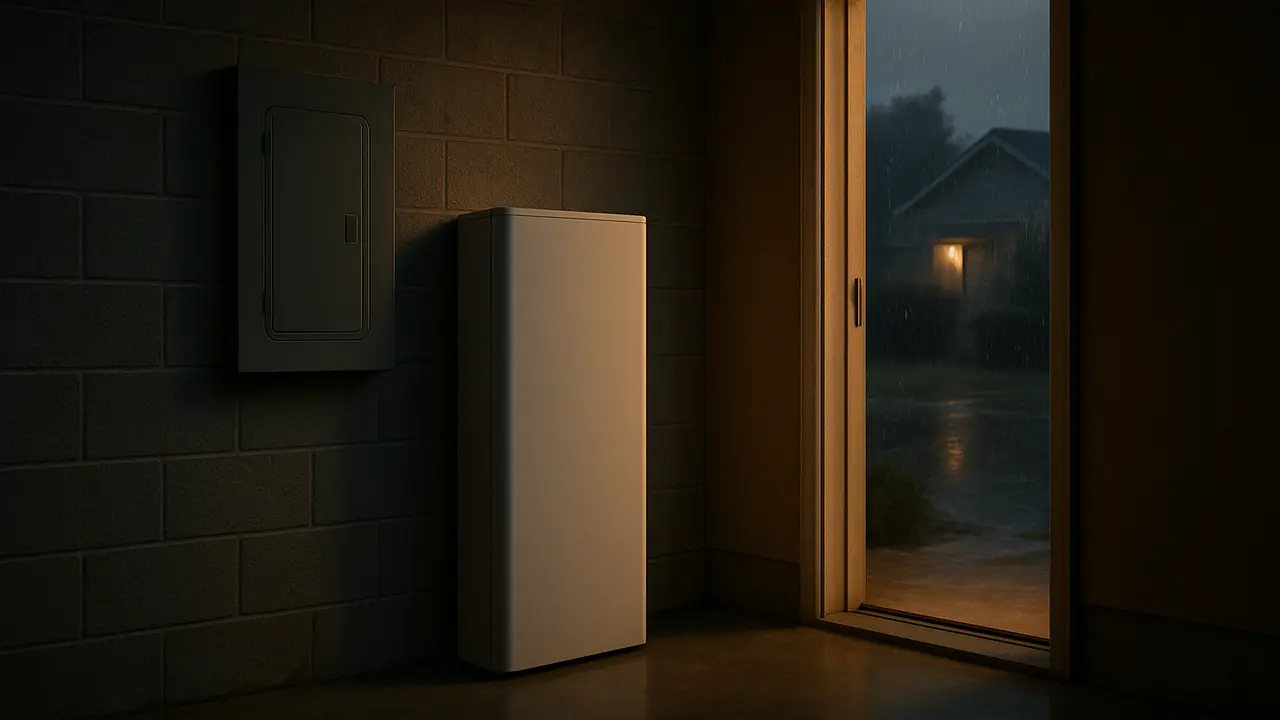
Home battery backup keeps selected lights, outlets and appliances running when the grid goes down. A typical 13.5 kWh battery can carry a refrigerator, internet, lights and phone chargers for most of a day, and much longer if solar panels recharge it. Whole-home backup with air conditioning usually takes two or three batteries.
This guide covers what a battery can and cannot run, how to size one, how it compares with a generator, the safety codes that apply and what changed for costs and credits in 2026.
Grid-tied solar panels switch off automatically when the grid fails, so they will not send power onto lines that crews are repairing. The U.S. Department of Energy explains that keeping power on requires an inverter and a storage system that can island your home, meaning disconnect it from the grid and run it separately.
That surprises many owners after their first outage. The panels on the roof may be in full sun, yet the house is dark. DOE's Solar and Resilience Basics (opens in a new tab) page notes that solar generally depends on the grid to operate and is designed to shut off when grid power is cut.
A backup-ready system has three parts:
Batteries have gone from a niche add-on to a common part of new solar systems. Lawrence Berkeley National Laboratory reports that 37% of new U.S. residential solar systems in 2025 were paired with storage, up from 25% in 2024, with the largest jumps in California, Arizona and Texas.
The same Berkeley Lab 2026 data update (opens in a new tab) (August 2026) found the median residential battery paired with solar held 13.5 kWh in 2025, about the same as a year earlier. That is why our examples use 13.5 kWh. Power output per unit rose sharply, so newer batteries can start larger loads such as well pumps and air conditioners more easily.
Outages are also getting longer in some regions. The U.S. Energy Information Administration reports (opens in a new tab) that customers averaged about 11 hours without power in 2024, nearly twice the average of the decade before, mostly because of Hurricanes Beryl, Helene and Milton. South Carolina customers averaged nearly 53 hours. Homeowners in hurricane and ice-storm areas, such as those reading our guide to solar panels in Florida or Texas, feel this most.
A full 13.5 kWh battery running an average load of 800 watts lasts about 13.7 hours with no solar recharge, assuming a 10% reserve and 90% inverter efficiency. Runtime depends almost entirely on how much power you draw, so trimming your load is the cheapest way to make backup last longer.
Here is the math behind that figure. Usable energy is 13.5 kWh × (100% − 10% reserve) × 90% efficiency = 10.9 kWh. Divide by the 0.8 kW load and you get 13.7 hours. Try your own numbers below.
| Battery and load | Usable energy | Estimated runtime (no solar) |
|---|---|---|
| 13.5 kWh, 500 W essentials only | 10.9 kWh | 21.9 hours |
| 13.5 kWh, 800 W typical essentials | 10.9 kWh | 13.7 hours |
| 13.5 kWh, 800 W, starts at 80% charge | 8.5 kWh | 10.6 hours |
| 13.5 kWh, 1,500 W heavier use | 10.9 kWh | 7.3 hours |
| 27 kWh (two units), 1,200 W | 21.9 kWh | 18.2 hours |
Computed with our battery backup runtime calculator using a 10% reserve and 90% inverter efficiency.
Note the third row. Many owners let the battery cycle daily to save on time-of-use rates, so it may not be full when a storm hits. Most systems let you raise the backup reserve before a forecast storm. Do it.
With solar recharging, the picture changes. On an average day, a 7 kW system with 4.3 peak sun hours makes about 26 kWh, enough to refill one battery and run daytime loads. Cloudy winter days produce far less, so plan for your worst season, not your best.
One battery comfortably runs essential loads: refrigerator, freezer, lights, internet, phone and laptop charging, a TV, a medical device and a gas furnace fan. Large electric loads such as central air, electric ranges, water heaters, dryers and EV chargers drain a single battery in hours and are usually left off the backup circuits.
Sizing starts with daily energy, not panel count. Our solar battery size calculator adds up watts × hours for each item. Using its default essentials (a refrigerator running all day at an average 150 W, LED lights, a router, chargers, a TV and a few minutes of microwave), daily use is 5.7 kWh. After allowing for 90% usable capacity and losses, that calls for about 6.7 kWh of battery, so one 13.5 kWh unit covers a full day with room to spare.
| Backup plan | Daily energy | Battery needed | Typical units (13.5 kWh) |
|---|---|---|---|
| Essentials only (fridge, lights, internet, TV, chargers) | 5.7 kWh | 6.7 kWh | 1 |
| Essentials for 3 days with 4 kWh/day of solar recharge | 9.1 kWh total | 10.7 kWh | 1 |
| Essentials plus furnace fan (8 h), well pump (2 h), sump pump (1 h) | 12.5 kWh | 14.6 kWh | 2 |
| Essentials plus 3-ton central AC for 8 hours | 33.7 kWh | 39.5 kWh | 3 |
Calculated with the site calculator's default load values; your appliances may differ.
Power matters as well as energy. A well pump or air conditioner pulls a short surge when it starts. If the battery's continuous and surge power ratings are too low, the system can trip even with plenty of stored energy. Ask your installer for the battery's continuous kW and surge rating, and compare them with the nameplates on your largest motors.
Most homes do best with partial-home backup: a single battery wired to a short list of essential circuits. Whole-home backup covers every circuit but typically needs two or three batteries plus load controls, and it costs much more. Choose based on outage length, climate and medical needs.
There are two common wiring approaches:
Berkeley Lab research (opens in a new tab) funded by DOE has found that solar plus storage can keep critical loads running through multi-day outages in most of the country, but far fewer homes can run everything, especially homes with electric resistance heat in winter. Heat pumps fared better because they use less energy for the same heat.
A standby generator is cheaper per hour of long-outage backup and can run a whole house for days on fuel. A battery is silent, needs little maintenance, recharges from solar and can lower bills on time-of-use rates. Over 10 years, total costs can be close, so your outage pattern decides it.
Using example inputs in our battery vs generator cost calculator ($14,000 battery, $12,000 generator, $250 a year of generator maintenance, 24 outage hours plus 26 hours of self-testing at 1.5 units of fuel per hour and $2.50 per unit), the generator costs $16,375 over 10 years and the battery $14,000. Fuel alone is about $188 a year.
Change the inputs and the gap shifts. If outages last 60 hours a year and the battery also saves $500 a year on time-of-use rates, the battery's 10-year net cost drops to $9,000 while the generator's climbs to $17,725. If you rarely lose power and have no time-of-use rate, neither may pay off, and a portable power station for the fridge could be enough.
| Factor | Home battery | Standby generator |
|---|---|---|
| Runs during multi-day outage | Yes, if solar recharges it | Yes, as long as fuel lasts |
| Whole-home with central AC | Needs 2 to 3 units | Common with a large unit |
| Noise and fumes | None | Engine noise, exhaust |
| Routine upkeep | Software updates, little else | Oil changes, weekly self-tests |
| Lowers your electric bill | Yes, on time-of-use or net billing | No |
| Switchover | Near-instant | Usually several seconds |
For California homes, battery savings under net billing can be large, which we cover in our California NEM 3.0 guide. For whether a battery pays off on bill savings alone, read are solar batteries worth it.
Residential batteries must be listed and labeled to UL 9540, the safety standard for energy storage systems, and installed under your local building and fire code. Codes based on NFPA 855 and the International Residential Code limit each unit to 20 kWh and cap total storage in each location.
UL's summary of the 2021 residential requirements (opens in a new tab) (IRC Section R328 and NFPA 855 Chapter 15) lists the key rules:
States and cities adopt different code editions and amendments, so your local building department has the final word. The NFPA's storage fact sheet (opens in a new tab) (February 2024) points new installations to the 2023 edition of NFPA 855 and notes that a battery management system should monitor the modules and disconnect them when something goes wrong.
Battery prices vary widely by brand, capacity and how much rewiring your panel needs. Berkeley Lab found that cash-purchased residential solar systems with storage had median prices $2.1 per watt higher than solar alone in 2025, which works out to roughly $14,700 extra on a 7 kW system.
That figure comes from the Berkeley Lab 2026 data update (opens in a new tab), and about 80% of its paired pricing data comes from California, so prices elsewhere may differ. Our calculators use $14,000 as a round example. Always get itemized quotes that separate the battery, the backup gateway and any panel upgrade.
The federal credit picture changed this year. As of October 2026, the 30% Residential Clean Energy Credit (Section 25D) no longer applies to a battery you own if its installation was completed after December 31, 2025. The IRS FAQ on the 2025 law changes (opens in a new tab) says the expenditure is treated as made when installation is completed, so paying a deposit in 2025 does not count. Batteries of at least 3 kWh finished in 2025 are claimed on the 2025 return using Form 5695, per the IRS Residential Clean Energy Credit page (opens in a new tab).
If a company owns the battery under a lease or service plan, the owner may still claim a business storage credit under separate rules with a longer timeline. You do not claim it, but it may lower the price you are offered. State and utility battery programs also still exist in some areas; check your utility's website and your state energy office.
Plan backup in a few steps: list must-have loads, estimate daily energy and peak power, decide how many days you want covered, then choose partial- or whole-home wiring. Get at least two quotes that show the battery's usable kWh, continuous kW and which circuits are backed up.
A battery is a long-term purchase, so read the warranty for both years and energy throughput, and confirm who services it locally. The DOE Homeowner's Guide to Solar (opens in a new tab) suggests asking your installer directly which storage options they support and how outage backup will work in your home.
Not on their own. Grid-tied solar systems are designed to shut off when the grid goes down so they do not send power onto lines that utility crews are repairing. To keep power on, you need a battery and an inverter that can disconnect your home from the grid and run it as a small island.
About 13.7 hours at an average load of 800 watts, starting full, with a 10% reserve and 90% inverter efficiency. Cut the load to 500 watts by running only the fridge, internet, lights and phone chargers and it stretches to about 22 hours. Daily sunshine on your panels can recharge it and extend that much further.
Sometimes, but it drains a battery fast. A 3-ton central AC or heat pump can draw about 3,500 watts while running, so eight hours of cooling uses about 28 kWh, more than two typical batteries hold. Many owners back up a smaller mini-split or a single window unit instead, or add load controls.
No. A battery can charge from the grid and sit ready for outages. Without solar it cannot recharge during a long outage, though, so it only lasts as long as its stored energy. Pairing it with solar lets it refill on sunny days, which matters most in multi-day storm outages.
Batteries listed to UL 9540 and installed under your local fire and building code are designed for homes. Model codes based on NFPA 855 limit each unit to 20 kWh, cap total storage by location and keep batteries out of sleeping rooms. Your permit inspection checks these rules, so never skip the permit.
It depends on how you use it. With example inputs of a $14,000 battery costs $2,375 less over 10 years than a $12,000 generator with fuel and maintenance. A generator is still better for very long outages or whole-home loads, while a battery wins if it also cuts your bills on time-of-use rates.
Not the federal 25D credit if you own the battery and installation finished in 2026. The credit ended for expenditures after December 31, 2025, and the IRS counts the expenditure when installation is completed. Check your state and utility for battery rebates, which still exist in some areas.
Most homes need two or three 13.5 kWh units for true whole-home backup with air conditioning or electric heat. In our example, adding eight hours of 3-ton AC to essential loads raised daily use to 33.7 kWh, which calls for three units. Load management can shrink that number.
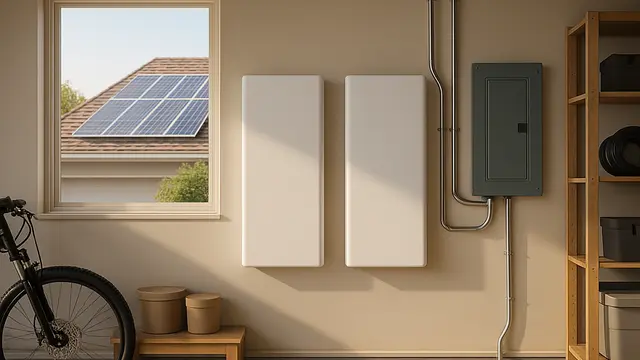
Are solar batteries worth it? See 2026 battery costs, when time-of-use savings and backup pay off, and why the answer differs in CA, AZ and TX.
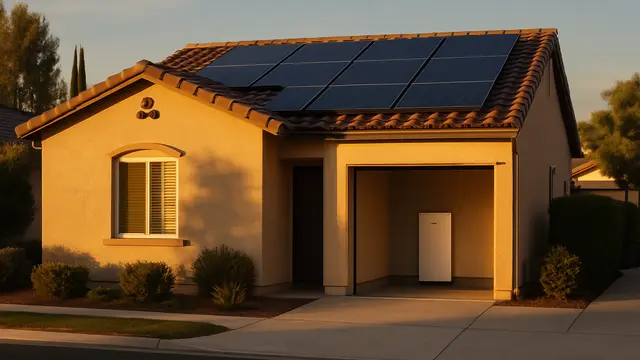
California NEM 3.0 pays a few cents for exported solar. See how net billing, the 9-year lock-in and the new fixed charge shape savings in 2026.
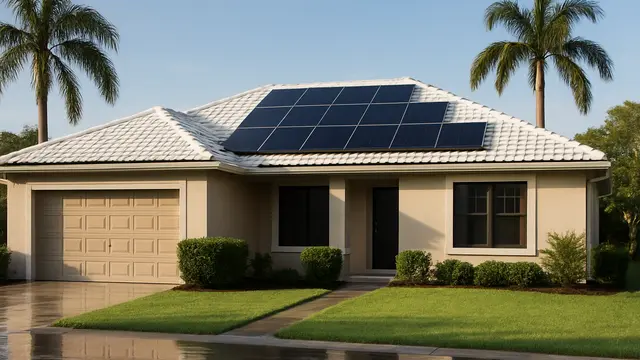
Solar panels in Florida in 2026: how PSC net metering works, sales and property tax exemptions, HOA rights, hurricane backup and real savings math.
Are solar panels worth it in Texas? How buyback plans, Austin Energy and CPS rules, tax exemptions, HOA law and outages change your savings in 2026.