
How to Choose a Solar Installer: Licenses, Quotes, Warranties and Red Flags
How to choose a solar installer in 2026: check licenses and NABCEP certification, compare quotes per watt, read warranties and spot pressure tactics.
Compare up to three solar quotes on the same basis: price per watt and lifetime cost per kWh. Quotes for different system sizes are hard to compare by total price alone; this tool puts them side by side.
Results update as you type. Without JavaScript you see the worked example below.
A solar cost per watt calculator divides each quote's price by its size in watts, so systems of different sizes compare fairly, then spreads the price over 25 years of output to get a cost per kWh. With the defaults, Quote A is $3.00 per watt, about 9.4¢ per kWh over 25 years, and Quote B is $3.36 per watt.
The results show the lowest price per watt, each quote's price per watt and the lowest quote's lifetime cost per kWh. Two bar charts compare the quotes: one on dollars per watt, one on cents per kWh over 25 years. This tool has no schedule or scenario table, because the quotes you enter are the comparison.
Price per watt   = price ÷ (kW × 1,000)
Lifetime kWh     = Σ over 25 years of kW × yearly output per kW × (1 − degradation)^(year−1)
Cost per kWh     = price ÷ lifetime kWh
Best quote       = lowest price per watt
Assumptions that match the code:
Default inputs: Quote A $23,100 for 7.7 kW, Quote B $25,500 for 7.6 kW, no Quote C, 1,350 kWh per kW, 0.5% degradation.
Second example, three Florida bids: yearly output 1,568 kWh per kW (PVWatts for Tampa).
| Quote | Price | Size | Price per watt | 25-year cost per kWh |
|---|---|---|---|---|
| A | $26,000 | 8.0 kW | $3.25 | 8.8¢ |
| B | $24,500 | 6.8 kW | $3.60 | 9.8¢ |
| C | $31,000 | 9.2 kW | $3.37 | 9.1¢ |
Quote B has the lowest total price but the highest price per watt. Quote A buys 18% more capacity for 6% more money.
A low price per watt means you are paying less for each unit of capacity. It does not mean the system is right for you. If one quote is far below the others, ask what is missing: permits, a main panel upgrade, roof work, monitoring or a workmanship warranty. If one is far above, ask what extra equipment or service it includes and whether a cash price is available. Check the size against your use with how many solar panels do I need, and check the price against national benchmarks in the solar panel cost calculator and our guide to how much solar panels cost.
| Benchmark | Price per watt |
|---|---|
| Cash purchase median | $3.00 |
| All host-owned median | $3.60 |
| Loan-financed median (includes dealer fees) | $4.50 |
| Solar plus storage median (per PV watt) | $4.90 |
Values are from LBNL's 2026 data update as read from its charts (LBNL (opens in a new tab)).
This is an educational comparison. It does not judge equipment quality, warranty terms, roof work, permits or the installer's reliability, and its cost per kWh ignores financing, upkeep and incentives. Use it to narrow your choices, then read each proposal in full. Our guide on how to choose a solar installer covers the checks that price cannot.
As a reference point, LBNL's 2026 data update reports 2025 medians of about $3.00 per watt for cash purchases and $3.60 for all host-owned home systems, with loan-financed systems near $4.50 because of dealer fees. About 60 percent of large installers had medians under $4 per watt. Local prices vary, so compare several written bids.
Divide the total price by the system size in watts. A $23,100 quote for 7.7 kW is $23,100 ÷ 7,700 W = $3.00 per watt. Use the DC size from the quote, and use the cash price, not a financed price that includes a dealer fee.
Cost per watt tells you what you pay for capacity; cost per kWh tells you what you pay for energy over the system's life. If two quotes put panels on different roof faces, or one uses a different design, their expected output per kW can differ. Enter each quote's own production estimate divided by its kW to compare on energy.
Often the one with the lower price per watt, as long as you need the extra capacity. In our Florida example, a $24,500 quote for 6.8 kW costs $3.60 per watt, while a $26,000 quote for 8.0 kW costs $3.25. Check that the larger system fits your use and your utility's export rules before paying for more panels.
No. Compare equipment, warranties on panels, inverters, workmanship and roof penetrations, the installer's licensing and record, and whether the price includes permits and any electrical upgrades. NABCEP certification is a widely recognized credential for installers, according to DOE.
No. It uses the price you enter. As of October 2026, systems completed after December 31, 2025 do not get the 25D homeowner credit, so a quote that subtracts a 30 percent federal credit for a 2026 install should be questioned.
It lets you compare solar with buying power from the utility. With the defaults, Quote A works out to about 9.4 cents per kWh over 25 years, against a 2025 US average residential price of 17.30 cents per kWh. It excludes financing costs, upkeep and the value of exports, so treat it as a rough benchmark.
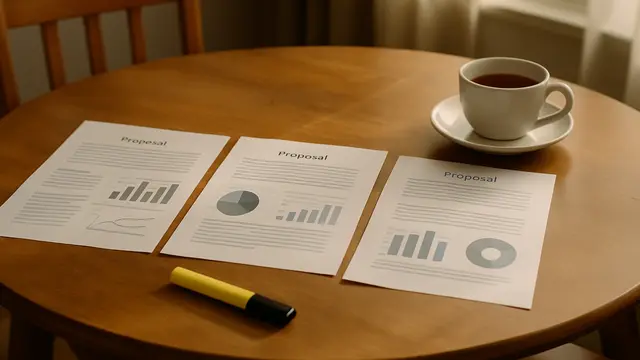
How to choose a solar installer in 2026: check licenses and NABCEP certification, compare quotes per watt, read warranties and spot pressure tactics.
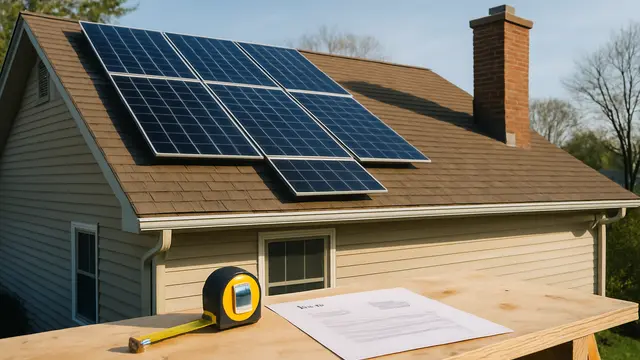
How much do solar panels cost in 2026? Real installed prices per watt from Berkeley Lab, costs by system size, battery add-ons, and why no federal credit now.

Spot solar scams before you sign: fake free-solar offers, expired tax credit pitches, hidden dealer fees and pressure tactics. A 2026 checklist.

Solar lease vs PPA vs loan vs cash in 2026: how each works, 25-year costs, escalators, home-sale rules and what the end of the 25D credit changes.