
What Is Net Metering? Net Metering vs Net Billing, Explained With Real Numbers
What is net metering? Learn how utilities credit the solar power you export, how net billing differs, and how much each rule is worth on a typical home.
Solar panels in Arizona in 2026: APS, TEP and SRP export rates, the $1,000 state tax credit, property tax rules, HOA law and real savings math.
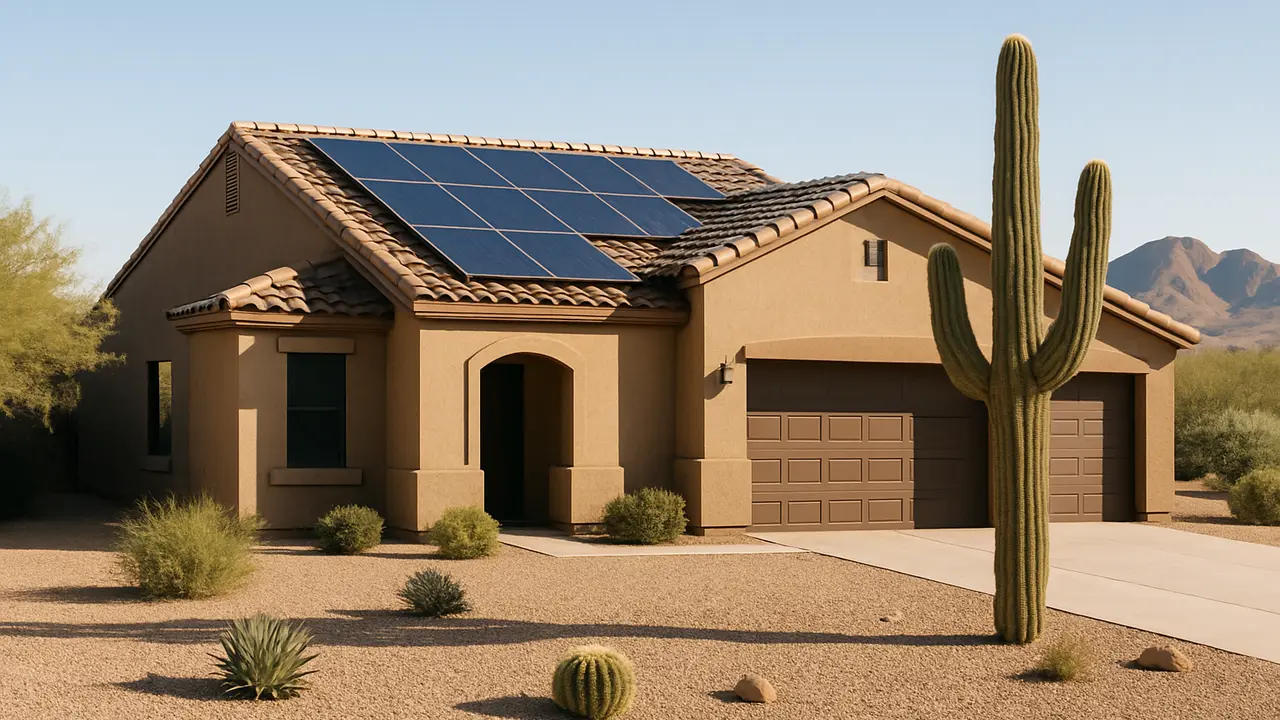
Solar panels in Arizona produce more power per panel than almost anywhere in the country, but in 2026 their value depends on your utility's export rate. APS, TEP and UNS Electric pay a Resource Comparison Proxy (RCP) rate locked for 10 years, SRP sets its own plans, and a $1,000 state tax credit helps.
Arizona's regulated utilities credit exported solar at a fixed RCP export rate rather than the full retail price. APS pays 5.554¢/kWh for its 2026 tranche and TEP pays 4.62¢/kWh, each locked for 10 years from interconnection. SRP, a public power utility not regulated by the state commission, uses its own market-based export price.
The RCP system began with an Arizona Corporation Commission (ACC) decision in 2017. APS's current Rate Rider RCP tariff (opens in a new tab), effective September 1, 2026, spells out the rules:
Here is how the APS rate has stepped down, from the same tariff:
| APS tranche | Export rate (¢/kWh) |
|---|---|
| 2017 | 12.900 |
| 2019–2020 | 10.450 |
| 2022 | 8.465 |
| 2024 | 6.857 |
| 2025 (Sept 2025 – Aug 2026) | 6.171 |
| 2026 (Sept 2026 – Aug 2027) | 5.554 |
| Tranche | Export rate (¢/kWh) |
|---|---|
| 2017 | 12.9¢ |
| 2019–2020 | 10.5¢ |
| 2022 | 8.5¢ |
| 2024 | 6.9¢ |
| 2025 | 6.2¢ |
| 2026 | 5.6¢ |
Source: APS Rate Rider RCP tariff, effective September 1, 2026 (as of 2026-10)
TEP's RCP page (opens in a new tab) says its export rate of $0.0462 per kWh is in effect from October 1, 2026 through September 30, 2027, with the same 10% cap and 10-year lock. If you went solar on APS before the RCP took effect, your older buyback rate lasts 20 years from your connection date.
For background on how export credits differ from classic net metering, see our net metering explainer.
A 7 kW system in Phoenix makes about 12,285 kWh a year. For a home using 14,000 kWh and consuming 45% of its solar directly, first-year savings are roughly $1,229 on APS's 2026 export rate and $1,166 at TEP's rate. Under old full-retail net metering, the same system would save about $1,897.
How we built the example:
| Export credit | Self-use (5,528 kWh) | Exports (6,757 kWh) |
|---|---|---|
| APS RCP (5.554¢) | $854 | $375 |
| TEP RCP (4.62¢) | $854 | $312 |
| Full retail (15.44¢) | $854 | $1,043 |
Source: Worked example: PVWatts Phoenix 1,755 kWh/kW; EIA Arizona Jan–Jul 2026 rate 15.44¢; APS and TEP RCP tariffs (as of 2026-10)
| Export credit | Value of exports, year 1 | First-year savings | 25-year savings | Simple payback |
|---|---|---|---|---|
| APS 2026 RCP (5.554¢) | $375 | $1,229 | $41,893 | 14.7 years |
| TEP 2026–27 RCP (4.62¢) | $312 | $1,166 | $39,741 | 15.4 years |
| Old full-retail net metering (15.44¢) | $1,043 | $1,897 | $64,665 | 9.9 years |
One caution: our calculator grows all savings by 3% a year, but an RCP export rate is locked for 10 years and does not rise. Because exports are a small share of savings here, the effect is modest, but treat the 25-year figures as a rough guide.
| Simple payback | |
|---|---|
| APS RCP 2026 | 14.7 years |
| TEP RCP 2026–27 | 15.4 years |
| Old full-retail | 9.9 years |
Source: Worked example: $21,000 (7 kW at $3.00/W) minus $1,000 Arizona credit, $100/yr upkeep, 3% price growth, 0.5%/yr panel loss (as of 2026-10)
Put in your own bill and system size in the solar savings calculator. Choose Arizona, then set the export credit as a share of your retail rate: about 36% for APS's 2026 rate if you pay around 15.4¢.
APS solar customers must be on a time-of-use plan with a 4 to 7 p.m. weekday peak, and a small monthly grid access charge for newer solar customers is now in legal limbo. SRP keeps its own solar plans and removed extra grid access fees for solar customers starting with the November 2025 billing cycle.
The ACC reaffirmed APS's grid access charge (opens in a new tab) on December 17, 2024, describing it as a "nominal fixed charge – between $2 and $3 a month" paid by about 111,000 residential solar customers. On June 16, 2026, the Arizona Attorney General announced (opens in a new tab) that the Court of Appeals vacated that decision and the underlying charges and sent the matter back to the Commission. APS also has a new rate case before the ACC, so ask your installer to model your bill on the rate plan that will actually apply.
SRP's board materials for its February 27, 2025 pricing decision (opens in a new tab) set these changes, effective with the November 2025 billing cycle:
Check SRP's current solar price plan page for the exact export price before you sign.
Arizona gives a state income tax credit of 25% of the cost of a solar energy device, up to $1,000 per residence. It also treats solar as adding no value for property tax, and deducts sales of solar energy devices from the state sales tax base. The federal 25D credit ended for systems completed after December 31, 2025.
On the federal side, as of October 2026 homeowners cannot claim the Residential Clean Energy Credit for a system completed this year. A leasing company may still claim a business credit on systems it owns. Our state-by-state incentives guide compares Arizona with neighboring states.
An Arizona HOA cannot prohibit solar panels. A.R.S. §33-1816 lets it adopt reasonable placement rules only if those rules do not prevent installation, impair the system, restrict its use, or adversely affect its cost or efficiency. Deed restrictions that effectively ban solar are also void.
The statute is short and strong. A.R.S. §33-1816 (opens in a new tab) says: "Notwithstanding any provision in the community documents, an association shall not prohibit the installation or use of a solar energy device." If you sue over a violation and substantially prevail, the court awards you attorney fees.
In practice, submit your plans to the architectural committee with the panel layout and a production estimate. If the HOA asks you to move panels to a face that produces noticeably less, the production difference is your evidence that the rule affects efficiency.
Arizona's heat lowers panel efficiency slightly on the hottest afternoons, but strong sun more than makes up for it, which is why Phoenix yields about 1,755 kWh per kW a year. Under export rates and an evening peak, west-facing panels can be worth more than their lower annual output suggests.
Panel output falls a little as cells heat up, so good airflow under the panels helps. Most Arizona homes mount panels flush to the roof, and that is usually fine. In Phoenix, at about 33.5° north, the rule-of-thumb best fixed tilt is about 33°, while a common 4-in-12 roof sits at about 18.4°. A tilt lower than latitude favors summer production, which is when Arizona homes use the most power for cooling.
Check your roof with the solar panel angle calculator. If your best roof faces west, ask for a production estimate for both west and south. West panels produce more of their power later in the day, closer to the 4 to 7 p.m. peak, so less of it is exported at the low RCP rate.
A battery makes more sense in Arizona than in full net-metering states, because exports earn about a third of the retail price and peak pricing runs into the evening. A battery stores midday solar and uses it during the peak, turning low-value exports into high-value self-use. Utility programs can add some income.
APS's Storage Rewards program pays $110 per average kW of battery support across a May to October season, with events usually between 4 and 10 p.m. TEP and SRP run their own battery programs; check current terms on their sites. Our guide to whether solar batteries are worth it shows how to compare battery savings with the price.
A rough way to judge it: each kWh a battery shifts from export to evening use is worth roughly the gap between your peak price and the RCP rate. If that gap is 15¢ and the battery shifts 10 kWh on 250 days, that is about $375 a year before efficiency losses, so the battery's price and any program payments decide the answer.
Arizona law requires solar sales and lease contracts to show the total cost in bold, give you three business days to cancel before installation, explain how savings were estimated, and include a warning that utility rates and tax incentives can change. Lease payments cannot start before the utility approves the system.
Under A.R.S. §44-1763 (opens in a new tab), the contract must also list warranties for panels, inverters, racking and batteries, disclose incentives and taxes, and include a written roof repair acknowledgment. A related statute requires the installer to warrant major components for at least two years or provide a production guarantee.
Before you sign, use this checklist:
Then run your numbers in the solar savings calculator and check your roof angle in the tilt calculator. In Arizona, the sun is a given; the export rate and how much solar you use at home decide the payoff.
Not for new customers of APS, TEP or UNS Electric. Since 2017, the Arizona Corporation Commission's Resource Comparison Proxy pays a set export rate, locked for 10 years. Customers who went solar before the change keep their old buyback rate for 20 years from interconnection, and SRP sets its own rules.
5.554¢ per kWh for customers in the September 1, 2026 to August 31, 2027 tranche, according to APS's RCP tariff. That rate stays locked for 10 years from interconnection. If you apply before September 1 and finish within 180 days, you keep the earlier tranche's rate.
Yes. A.R.S. §43-1083 gives a credit of 25% of the cost of a solar energy device, capped at $1,000 per residence, with no sunset date in the statute. You claim it on Arizona Form 310, and unused credit carries forward up to five years.
No. A.R.S. §42-11054 says solar energy devices and grid-tied solar systems are considered to add no value to the property they are installed on. You do not need a separate application for that treatment in the statute.
It is in flux. The Arizona Corporation Commission described it as a charge of about $2 to $3 a month and reaffirmed it in December 2024, but the Arizona Court of Appeals vacated that decision and sent it back to the Commission in June 2026. APS's pending rate case may change solar charges again in 2027.
SRP is not regulated by the Corporation Commission and sets its own solar price plans. Its board approved a 23% increase to the export rate based on a market price index starting with the November 2025 billing cycle, plus removal of extra grid access fees for solar customers. Check SRP's current solar price plan page for the exact rate.
No. A.R.S. §33-1816 says an association shall not prohibit installing or using a solar energy device. It can set reasonable placement rules, but only if they do not impair the device or adversely affect its cost or efficiency.
It can be, because exports earn about a third of the retail price and peak periods run into the evening. A battery stores midday solar for the 4 to 7 p.m. peak on APS plans. Utility battery programs, such as APS Storage Rewards, can add some yearly income.
What is net metering? Learn how utilities credit the solar power you export, how net billing differs, and how much each rule is worth on a typical home.
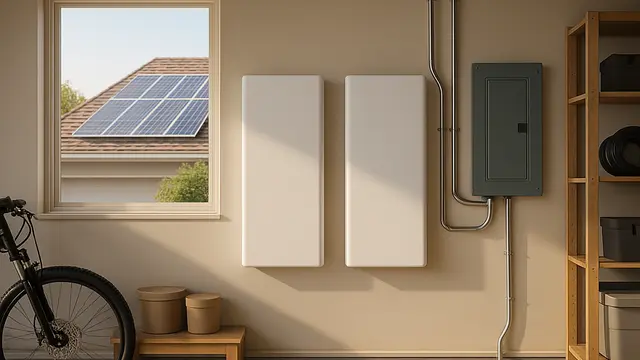
Are solar batteries worth it? See 2026 battery costs, when time-of-use savings and backup pay off, and why the answer differs in CA, AZ and TX.

Solar incentives by state for 2026: state tax credits, property tax exemptions, rebates, SRECs and the export rules that matter most now that 25D is gone.

Spot solar scams before you sign: fake free-solar offers, expired tax credit pitches, hidden dealer fees and pressure tactics. A 2026 checklist.